Nonintervention and Witnessing Death
The Character of RainNonintervention and Witnessing Death is the Narrator (God)’s interpretation of a repeated and unsettling spectacle: people see another person in danger, yet do not intervene. First formed during her childhood near-drowning in Japan, this idea links a personal encounter with death to a religious image, a later attempted death in the family’s koi pond, and the mass deaths of Okinawans after Japan’s surrender in 1945. The narrative presents nonintervention both as a principle the child believes others obey and as a framework through which the adult narrator examines fear, choice, and the meaning of rescue.
The Sea and the Japanese Principle
As a child, the Narrator (God) loses her footing while walking out into the sea and realizes she is drowning. When she surfaces, she can see the distant beach, her sleeping parents, and people watching from the shore. In her account, those onlookers follow The Japanese Principle of Not Rescuing Others: helping a person would create a debt of gratitude so burdensome that it is better not to intervene. The scene’s defining horror for the child is therefore not only her danger, but the public attention directed at it without assistance.
She calls out first in Japanese and then in French. Her earlier reluctance to speak French suddenly seems absurd to her, and she wonders whether the water has somehow forced her to acknowledge the language spoken by her parents. Yet she also understands that her parents cannot hear her. The crowd, in her interpretation, will not even alert them. That distinction sharpens the idea of nonintervention: the bystanders do not merely decline to enter the water; they also leave the child without a warning that might bring help. The account does not establish that this principle is an objective national rule. It shows how the child explains the crowd’s behavior while alone and in danger.
The Religious Image as a Parallel
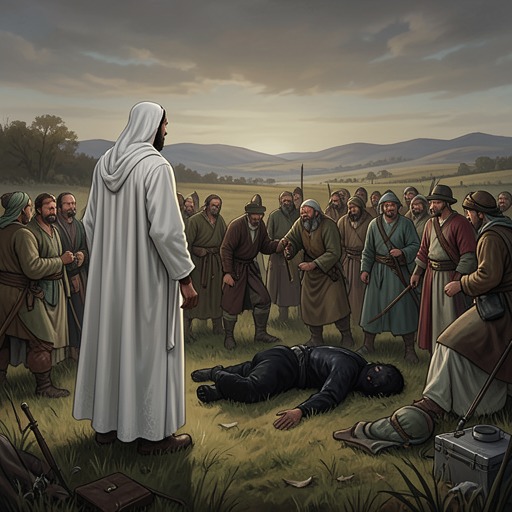
Later, an image of Jesus being crucified gives the Narrator (God) a visual parallel for what she experienced. She learns that the nails cause his death, and finds the image more fascinating because Jesus appears to be dying in front of a crowd that does not save him. She connects the figures in the scene to the people who watched her in the sea: in both cases, she imagines, someone could have acted, but the observers remained uninvolved.
The child extends her explanation beyond Japan, deciding that the people in the image’s setting must follow a similar principle: rescue would impose an excessive debt of gratitude and limit the rescued person’s freedom. She does not question this precept; what she recognizes is the terror of dying while other people watch. Her sense of kinship with Jesus is grounded in that witnessed vulnerability, not in an account of shared religious belief. Wanting to know more about the story, she decides that books hold the truth and resolves to learn to read them. When she tells her family, they laugh at her decision.
The Koi Pond and the Observer
The principle returns in a different form when the Narrator (God) enters the koi pond intending to die. Her garden, once understood as a refuge, no longer seems separate from danger. She collapses into the pool and settles beneath its surface; unlike during the earlier sea incident, she does not feel a desire to return to the air. This contrast makes the two episodes more than repetitions: the first is an unwanted emergency, while the second is understood by the child as a choice.
Kashima-san leans over the water. The Narrator (God) recognizes her and believes she will not intervene, associating that expectation both with Kashima-san’s hostility toward her and with the nonintervention she has attributed to Japan. Kashima-san looks at her without an obvious response, then moves away. The child reads the woman’s composure as acceptance that the Narrator (God) is destined to drown. She also imagines that they will one day understand one another, and revises her earlier revulsion at the people on the beach: in this moment, Kashima-san’s calm helps her understand their stillness as obedience to a supposed order of the universe.
The episode makes witnessing itself a relation between two people. The Narrator (God) attends closely to Kashima-san’s face and believes that rescue would have contradicted the woman’s identity. This is the child’s interpretation, not independent confirmation of Kashima-san’s motives. The later disclosure that the Narrator (God) does not tell her mother the truth preserves that gap: she decides to maintain the official account and does not know the word for suicide. Her silence shows that the event remains difficult for her to name, even as she continues to interpret it through the language of choice and noninterference.
Okinawa and the Scale of Collective Death
The narrative widens the subject from an individual child to Okinawa shortly after the 1945 surrender. The island’s inhabitants know that the war is over and that the latest orders are to stop resisting, but they also believe earlier assurances that the Americans will kill every Japanese person. As American forces advance, many residents retreat to the island’s cliffs and leap to their deaths. The account presents their actions in the context of wartime fear and misinformation, rather than treating them as an isolated expression of individual choice.
When the Narrator (God) visits the cliffs in 1989, she sees no sign marking what happened there. Thousands died within hours, and the sea has left no visible trace of the bodies. She reflects that visitors cannot easily stand at the site without imagining the circumstances of those who jumped. Some may have feared torture; for others, the setting may have given the act a meaning connected to patriotism. The narrator does not claim to know each person’s reason. Instead, she identifies a paradox in the reported mass deaths: people chose death to avoid being killed, and fear of dying may itself have driven the choice.
Meaning and Limits of the Principle
Across these scenes, nonintervention changes from the child’s explanation of a watching crowd into a way to compare private and collective encounters with death. The beach crowd, the crowd in the religious image, and Kashima-san are linked by the narrator’s attention to people who witness danger without stopping it. The Okinawa account complicates that pattern: there, the central question is not simply whether a bystander will rescue someone, but how collective belief, wartime orders, and fear shape the choices available to an entire population.
The narrative does not resolve the conflict between rescue and nonintervention into a general moral rule. In the sea, the child desperately needs help; in the pond, she believes she has chosen death and finds meaning in Kashima-san’s refusal to disturb that choice. Her interpretations are shaped by a child’s understanding and by the story’s recurring images of water, watching, and silence. Together, the episodes show how the same absence of intervention can be experienced first as abandonment, later as recognition, and finally as part of a larger inquiry into what fear makes people do.